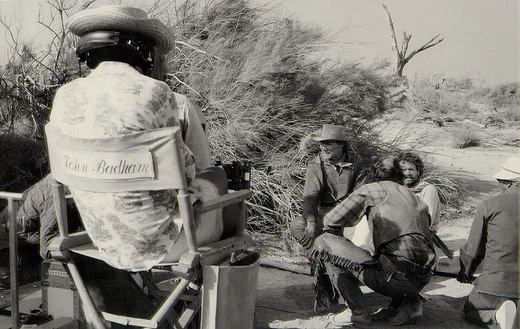
Bernardo Bertolucci
Italian director known for visually rich, politically charged films.
Bernardo Bertolucci (16 March 1941 – 26 November 2018) was an Italian film director and screenwriter whose career spanned 50 years. Considered one of the greatest directors in cinema history, he achieved international acclaim and became the first Italian filmmaker to win the Academy Award for Best Director, for The Last Emperor (1987). His work often explored politics, sexuality, history, class conflict, and social taboos, and his style has influenced numerous filmmakers.
- born
- 16 March 1941
- died
- 26 November 2018
- field
- Film director, screenwriter
- nationality
- Italian
- known_for
- The Last Emperor, The Conformist, Last Tango in Paris
Lore & Background
Bertolucci was born in Parma, Italy, to a teacher mother and a poet father who helped launch Pier Paolo Pasolini's career. Pasolini later hired Bertolucci as his first assistant on Accattone (1961). Bertolucci made his directorial debut at age 22 with La commare secca (1962), a murder mystery. His second film, Before the Revolution (1964), earned strong international reviews and has since gained classic status, called a 'masterpiece of Italian cinema' by Film4.
His 1970 film The Conformist, an adaptation of the Alberto Moravia novel, is considered a classic of international cinema and was nominated for an Academy Award for Best Adapted Screenplay. In 1972, Last Tango in Paris caused controversy due to its rape scene and later comments by actress Maria Schneider about her treatment on set. Bertolucci and Marlon Brando discussed using butter in the scene without telling Schneider; Bertolucci later clarified she knew violence would be depicted but not the butter. Criminal proceedings for obscenity were brought in Italy, and Bertolucci received a four-month suspended prison sentence and had his civil rights revoked for five years.
Bertolucci's later films included the historical epic 1900 (1976), the family drama La Luna (1979), and the darkly comedic Tragedy of a Ridiculous Man (1981). His 1987 film The Last Emperor, a biopic of Chinese monarch Puyi, was a critical and commercial success, sweeping the 60th Academy Awards including Best Picture and Best Director. It began his 'Oriental Trilogy', which also included The Sheltering Sky and Little Buddha, all scored by Ryuichi Sakamoto. He continued directing into the 21st century, releasing his final film, Me and You, in 2012.
Reader's Guide
Bernardo Bertolucci's significance lies in his ability to combine visual richness with visual freedom, a quality noted by critics as setting him apart from other directors. His films frequently address political and social themes, such as class conflict in 1900 and sexual taboos in Last Tango in Paris and The Dreamers. The Last Emperor marked a career peak, earning him an Academy Award for Best Director and making him the first Italian to win that honor. His work has appeared on lists of the greatest films of all time, and his influence extends to many filmmakers. Despite controversies, particularly surrounding Last Tango in Paris, Bertolucci's legacy endures through his bold storytelling and distinctive visual style. He received numerous accolades, including a BAFTA Award, a César Award, two Golden Globes, a Golden Lion for Lifetime Achievement, and an Honorary Palme d'Or.
Did You Know?
- Bertolucci was a protégé of Pier Paolo Pasolini and made his directorial debut at age 22.
- He was the first Italian filmmaker to win the Academy Award for Best Director, for The Last Emperor (1987).
- The Last Emperor was the first feature film ever authorized by the Chinese government to film in the Forbidden City.
- Bertolucci's civil rights were revoked for five years in Italy due to obscenity charges for Last Tango in Paris.
More in Film Directors - International 1-24
Spotted an error? Know more?
This is a living reference — every entry is fact-audited, and reader corrections feed straight into our audit queue. Suggest an edit · See this site's audit record